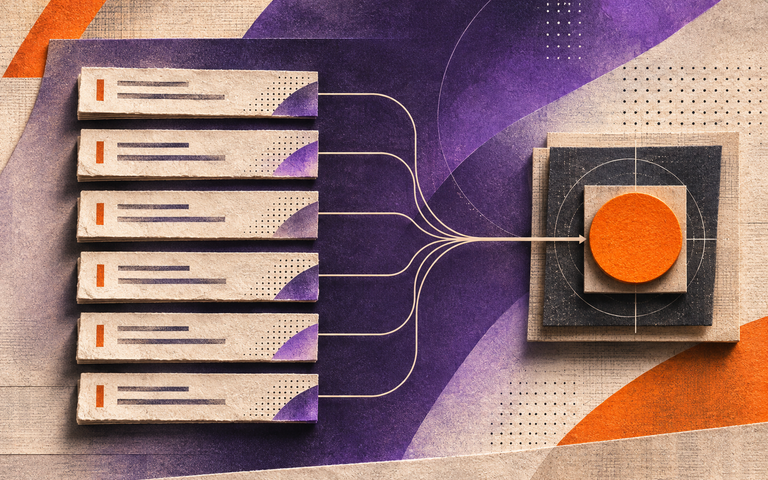
Six accounts can look like six reasons to believe something. But if all six repeat the same observation, the number tells you how far the account travelled. It does not tell you how many times anyone looked.
Copies do useful work. They make an account accessible, let it travel and give other people something to examine. The mistake is counting that movement as another independent encounter with the thing being described.
Imagine a research review in which several summaries support the same conclusion. One cites a report. Another cites an article about that report. A third was written from the first summary. Counting the documents makes the conclusion look well supported. Following their relationships shows that the apparent agreement may have only one root.
That is a different situation from several people making their own observations and reaching a similar conclusion. The page should make the difference visible. A collection of sources is more useful when you can see which ones depend on one another.
Independence still does not guarantee accuracy. People can look separately and be wrong. A shared source can also be right. Provenance gives you a way to examine those questions; it does not finish the judgment for you.
This matters when designing a record. Keep who made the observation, what they actually encountered, where interpretation entered, when the account was made and what it derives from. Keep criticism and competing accounts alongside the conclusion currently being used. Otherwise, each new summary can make the past look more settled than it was.
An operational decision also needs its context. Who had authority to make it? For what purpose? On what date? What replaced it? Those are things a system can record. They are more useful than asking one field to stand for truth.
The same principle applies when an agent gathers material for a person. A fluent synthesis can collapse several dependent accounts into a single confident answer. Preserving the links gives the person a chance to inspect where the support comes from and what remains uncertain.
The practical question is small enough to carry into the next review: trace these accounts back. How many independent looks are there?
Source and continuation
This standalone installment adapts the provenance argument in Leaving More Than the Answer, The Record, chapter 2, manuscript v2.15. It is one part of the larger work on how evidence, expertise and the conditions of making can survive being passed on.
Matt Hanson · adapted from manuscript v2.15 · November 2026